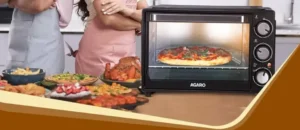
Electricity bills have a habit of growing without any obvious explanation. Nothing changed. Same cooking frequency, same recipes, same household. And yet the number keeps nudging upward. A lot of that creep comes not from how much you cook but from which appliance does the cooking. That distinction matters more than most people consider, and it is exactly where an oven toaster griller tends to make its strongest argument.
What the Wattage Numbers Actually Mean Day to Day
An average oven consumes power ranging from 2,000 to 5,000 watts per cycle. Anyone who has ever checked the back of their device knows that this is nothing out of the ordinary. However, when one compares these figures to the ones associated with an oven toaster griller, one will notice a huge difference. The latter falls somewhere around 800 to 2,000 watts.
To put things into perspective, a 1,000-watt OTG that runs for thirty minutes consumes about half a unit of power. A standard 3,000-watt oven will require three times more power in that amount of time, making an enormous difference in your monthly electricity bill if done once every three days over twelve months.
The 1,200 to 1,600 watts band suffices for all your home cooking requirements. Baking, grilling, toasting, or reheating, your OTG can handle all of it and will do it faster and much more economically than anything else.
Preheating Is Where Most People Lose Energy Without Realising
Nobody thinks about preheat time as a cost. They should.
It usually takes between fifteen and twenty minutes to heat the whole oven to a proper baking temperature. In that time frame, it consumes its maximum amount of energy but yields no product at all. It takes just five to eight minutes for an OTG to heat up to baking temperature since the heating elements in it are relatively close to the cooking area.
When the average time of your preparation comes out to be twenty-five minutes, then the preheating phase alone in a traditional oven constitutes almost half the entire time of your recipe’s execution. And in a week-long baking schedule, you can imagine how many units have gone to waste!
Matching Size to Actual Cooking Load
Here is something that rarely gets discussed properly. Running a large oven to cook a small quantity of food is inefficient, regardless of the appliance’s efficiency rating. The chamber heats to full capacity, whether you are baking one tray or six.
An oven toaster griller solves this structurally rather than behaviourally. Because models come in a range of capacities, you can choose one that is genuinely matched to what your household actually cooks rather than what it theoretically might cook on a large occasion.
| OTG Capacity | Suitable For | Approximate Wattage |
| 10 to 19 litres | 1 to 2 people, light use | 800 to 1,200W |
| 20 to 28 litres | Small families, regular baking | 1,200 to 1,500W |
| 30 to 40 litres | Larger families, frequent use | 1,500 to 1,800W |
| 45 litres and above | Heavy use, batch cooking | 1,800 to 2,000W |
A 20-litre oven toaster griller running at full load uses considerably less energy than a 60-litre conventional oven running at a third of its capacity for the same dish. The physics of that is straightforward. Less air to heat, less wall surface losing heat, and less distance between the element and the food.
For anyone looking to invest in an appliance that balances cooking performance with long-term running costs, browsing the available oven toaster griller range with attention to capacity and wattage is a sensible first step.
Small Habits That Compound the Savings Further
The appliance sets the baseline. What you do with it determines how far below that baseline your actual consumption falls.
Keeping the door shut during cooking matters more than most people expect. Every time it opens, hot air escapes and the heating rods draw extra power to recover the temperature. Unnecessary door checks across a week of regular cooking represent genuine wasted energy that adds up quietly.
Batch cooking helps significantly, too. One full session preparing several dishes uses the same preheat cycle as a single dish would, so the energy cost per item drops without any extra effort. Using the correct rack position ensures food receives direct radiant heat, meaning the elements work less hard to reach the same result.
Small habits, no discipline required, and they gradually widen the efficiency advantage of an oven toaster griller over time.
Conclusion
The efficiency case for an oven toaster griller is not built around one headline figure. It comes from several things working together. Lower wattage draw. Faster preheat. Compact chamber. Better size matching. Each one reduces the energy cost per cooking session by a small amount, and across consistent use, those small amounts add up to something genuinely worth caring about.
Smarter cooking rarely means cooking differently. It usually just means choosing the right tool for the task, and an oven toaster griller fits that description well.

“Welcome to the ultimate destination for the best Instagram captions! I’m James, your go-to guide for crafting the perfect caption to match any moment. Whether you’re posting a selfie, a scenic shot, or a fun group picture, I’ve got you covered with creative, catchy, and relatable captions for every occasion. Dive into my collection and discover the perfect words to express yourself on Instagram!”