Most people have heard the term, but few parents fully understand what it means in practice. A Reggio Emilia early learning centre is not just a place with nice materials and open spaces. It is a complete educational philosophy built around the belief that children are capable, curious, and competent learners from birth. Developed in post-war Italy by educator Loris Malaguzzi, the Reggio approach has been recognised by Newsweek as one of the ten best early childhood models in the world. In Australia, it has gained significant traction over the past decade as families seek more than rote learning and structured drills for their young children.
What Makes the Reggio Emilia Approach Different From Standard Childcare?
The biggest difference is the view of the child. In conventional early childhood settings, adults plan activities and children participate. In a Reggio-inspired programme, children drive the inquiry. Educators observe what children are interested in and build learning experiences around those interests.
This child-led approach is not hands-off. Educators actively document, question, and provoke deeper thinking. They are not managers of behaviour. They are partners in investigation. That distinction changes everything about how a room feels and how children engage.
How Does the Reggio Approach Support Cognitive Development?
Cognitive development in early childhood is about building neural connections, and those connections form fastest through open-ended play, problem solving, and meaningful exploration. Research published in the journal Early Childhood Education shows that child-led inquiry programmes produce stronger critical thinking skills than adult-directed models.
In Reggio-inspired settings, children regularly engage in complex, long-term projects called progettazione. A group might spend weeks exploring shadows, constructing ramps, or investigating how plants grow. These are not craft activities. They are investigations that build genuine scientific and mathematical thinking.
What Is the Role of the Environment in Reggio Learning?
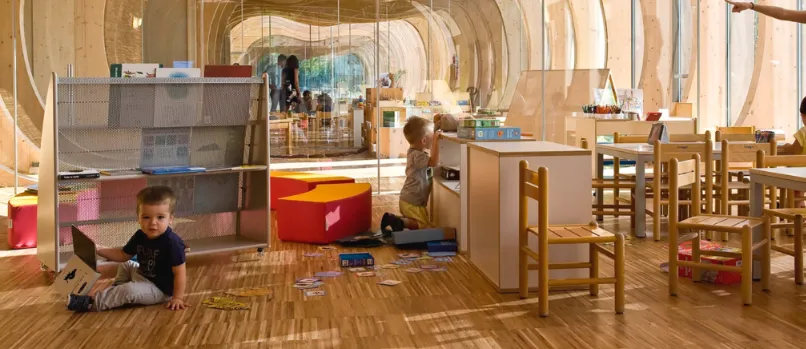
Malaguzzi famously called the environment the third teacher, after the child and the educator. The physical space is deliberately designed to invite curiosity. Natural light, open shelving, loose parts, mirrors, and real tools are standard features.
Children in these environments spend more time making choices, more time engaged, and more time collaborating with peers. A cluttered, overstimulating environment shuts curiosity down. A thoughtfully designed one opens it up. The research backs this. Environmental quality is one of the strongest predictors of engagement in early childhood settings.
How Does the Reggio Approach Handle Social and Emotional Development?
Relationships are central. The Reggio model emphasises long-term bonds between children and educators. Educators often stay with the same group of children for multiple years, a practice called looping. This continuity reduces transition stress and allows educators to deeply understand each child.
Social skills are built through collaboration, not instruction. When children work together on a project, they navigate disagreement, communicate ideas, and share resources. These are real-world skills. They cannot be taught through a feelings chart on the wall.
Is the Reggio Emilia Approach Aligned With Australian Curriculum Frameworks?
Yes. The Reggio approach maps well to Australia’s Early Years Learning Framework (EYLF). Both emphasise agency, identity, belonging, and learning through relationships. Reggio-inspired centres document children’s learning in detailed portfolios, which align with the EYLF requirement to assess and plan for individual children.
ACECQA rates many Reggio-inspired centres at the Exceeding NQS level, particularly across Quality Area 1 (Educational Program and Practice) and Quality Area 5 (Relationships with Children). The approach naturally produces the evidence and practice that the NQS rewards.
What Should Parents Look for in a Genuine Reggio-Inspired Centre?
Look at the walls first. In a genuine Reggio environment, walls display children’s work, their words, and their thinking processes. Not printed clipart and seasonal decorations. Documentation panels show what children have been exploring and how their thinking has evolved over time.
Then look at the materials. Natural, open-ended, and real. Blocks, clay, light tables, magnifying glasses. If everything is plastic and packaged, the approach may be Reggio in name only. Finally, ask educators to explain a recent project in the room. If they can describe children’s questions, their investigations, and what they discovered, the approach is real.

“Welcome to the ultimate destination for the best Instagram captions! I’m James, your go-to guide for crafting the perfect caption to match any moment. Whether you’re posting a selfie, a scenic shot, or a fun group picture, I’ve got you covered with creative, catchy, and relatable captions for every occasion. Dive into my collection and discover the perfect words to express yourself on Instagram!”