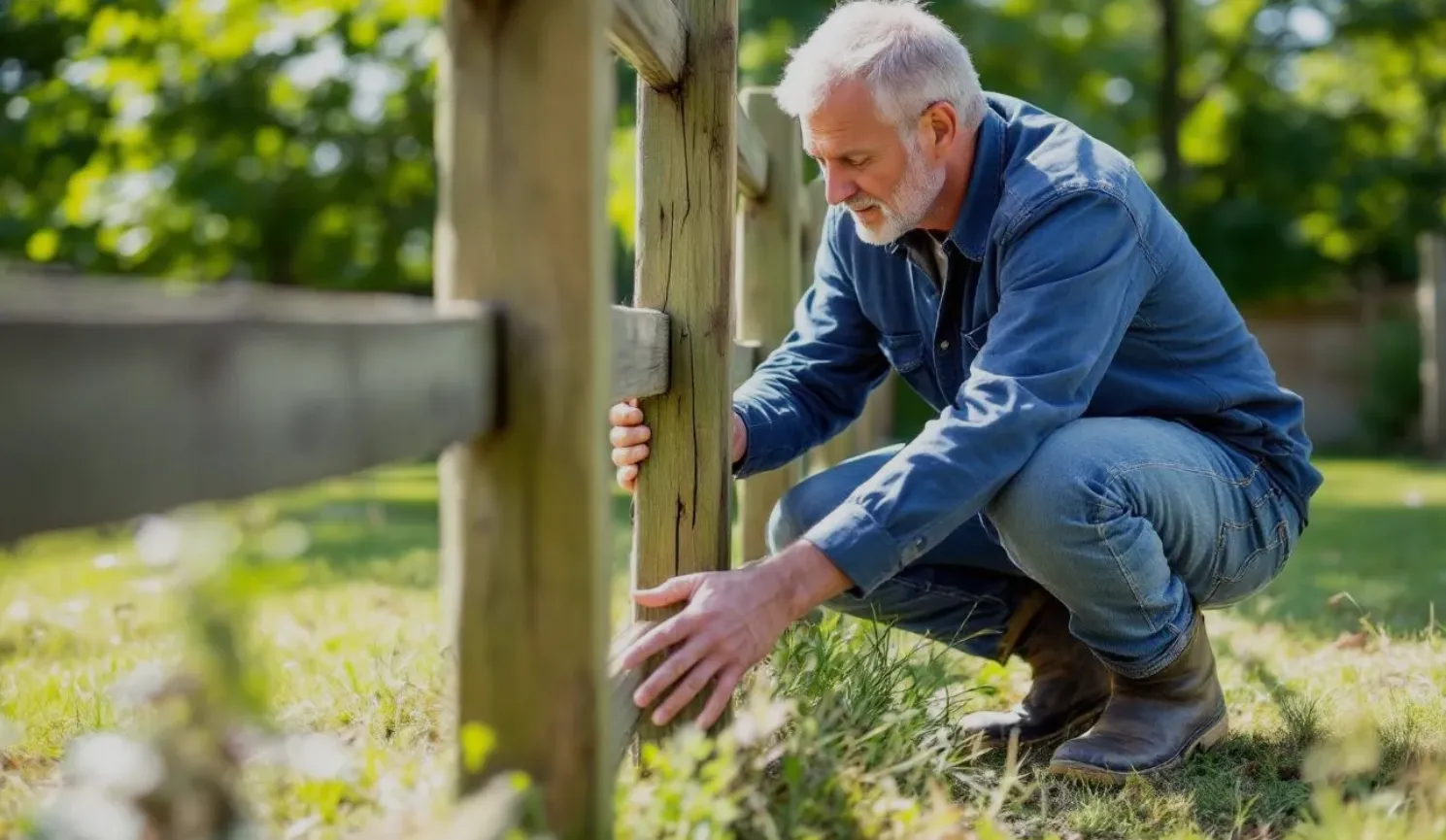
A single rotted post. A section knocked out by a storm. A gate that no longer closes right. These problems have a way of sitting there, quietly getting worse, while homeowners debate whether to patch it or pull it all out and start fresh.
It’s one of the most common decisions property owners face, and getting it wrong in either direction costs money. Fix too little and you’re back to square one in two years. Replace too aggressively and you’ve spent thousands on a fence that had years of life left in it.
The truth is, this decision depends on a handful of specific factors, and once you know what to look at, the answer becomes much clearer. This framework walks through each one.
Start With the Type of Damage, Not the Age
Most homeowners default to asking “how old is this fence?” That’s understandable, but age alone is a poor indicator. A 20-year-old wrought iron fence maintained properly can outlast a cheap wood fence installed five years ago.
The more useful starting point is the type and extent of damage you’re dealing with.
Surface Damage vs. Structural Damage
Surface damage includes rust staining, peeling paint, minor dents, small cracks in wood grain, and superficial corrosion. These issues affect appearance and, if left alone long enough, can progress into something worse. But at this stage, they’re almost always repairable without replacing the fence itself.
Structural damage is a different category. This includes:
- Posts that are rotted at the base, leaning, or no longer anchored securely
- Fence panels that have pulled away from the frame
- Rails that have snapped or buckled under load
- Ironwork that has corroded through the metal thickness, not just on the surface
- Gate frames that are twisted or warped beyond alignment
Once the structural integrity is compromised, repairs become a temporary patch rather than a real fix. That’s the threshold where replacement starts making more economic sense.
The 30 Percent Rule and Why It Matters
A rough benchmark used by many fence professionals: if more than 30 percent of the fence requires work, full replacement is usually more cost-effective than piecemeal repairs.
This isn’t an arbitrary number. When repairs are scattered across multiple sections, labor costs stack up quickly. You also run into the problem of mixing new materials with aged ones, which creates inconsistencies in appearance and, depending on the material, structural weak points at the joints.
For wrought iron and ornamental metal fences, this threshold is slightly more forgiving. Metal can be cut out, welded, and finished in ways that blend well with the existing structure, especially when the work is done by experienced professionals offering fence repair services. With wood fencing, however, matching weathered boards accurately is harder, and the repaired sections often look patched even when the craftsmanship is solid.
Material-Specific Guidance
Different fence materials fail in different ways, and that changes the repair-vs-replace calculus significantly.
Wrought Iron and Ornamental Metal
Wrought iron is one of the most repairable fence materials available. Surface rust, chipped paint, and even moderate corrosion can be treated, sanded back, primed, and repainted without touching the structure. Bent sections can sometimes be straightened. Broken pickets can be welded or replaced individually.
The case for replacement becomes stronger when the base metal has rusted through entirely, when posts have shifted out of plumb and the footings are failing, or when the overall design is so deteriorated that repair costs would approach the cost of new installation.
Chicago’s climate is particularly tough on metal fencing. Freeze-thaw cycles, road salt drift in winter, and the humidity that rolls in off Lake Michigan accelerate oxidation. A fence that’s been neglected through several winters may look worse than its actual structural condition, so it’s worth having a professional assess before assuming the worst.
Wood Fencing
Wood fences are the most susceptible to moisture damage, and moisture damage is almost always worse than it looks from the outside. A post that appears slightly soft at ground level may be completely rotted through two inches beneath the soil line.
The key inspection points for wood fencing are:
- Ground contact areas on posts (probe with a screwdriver, if it sinks easily, the wood is compromised)
- Bottom rails where water collects and sits
- Horizontal boards on the fence face where paint has peeled and moisture has entered
If fewer than three or four posts need replacing and the rails are sound, repair is typically the right move. If the posts are failing across the entire fence run, replacement is the cleaner answer. New posts with proper concrete footings and pressure-treated lumber will outlast a patched version by years.
Chain Link Fencing
Chain link is more forgiving than most materials. Individual sections of mesh can be replaced without touching the posts or framework. Posts that have rusted through at the ground line are the main structural concern, and these can often be replaced individually.
Full replacement of chain link typically makes sense when the entire mesh run is sagging, the tension has gone out of the fabric, or the gauge of wire is too light for its purpose and has deformed over time.
Aluminum Fencing
Aluminum doesn’t rust, which removes one of the major long-term maintenance concerns. But aluminum can crack or shatter under impact in cold weather, and individual pickets can break. Most aluminum fence systems are modular, so panel replacement is straightforward when the posts and rails are still intact.
Evaluate the Cost Trajectory, Not Just the Current Quote
One mistake homeowners make is comparing only the immediate repair cost against a full replacement quote. The more useful comparison is the projected cost over five to ten years.
A repair that costs $400 today might be the right call. But if that repair is likely to be followed by another $300 repair in 18 months, and then another section fails the year after that, the true cost of “repairing” is $700 or more over three years, for a fence that still has ongoing problems.
Replacement, by contrast, resets the maintenance clock. A well-installed fence in the right material for the environment should require minimal intervention for at least a decade.
Ask the contractor you’re working with to give an honest assessment of the fence’s remaining service life, not just a quote for the immediate repair. That conversation is worth having before committing to either path.
When Code Compliance and Safety Shift the Decision
For certain property types, the repair-vs-replace question isn’t purely financial. If a fence is part of a pool enclosure, it may be subject to local safety codes that require specific height and gap standards. A fence that was installed before those codes changed may need to be brought into compliance entirely, which often means replacement rather than repair.
Similarly, commercial property managers and landlords in Chicago need to think about liability. A fence that’s visibly deteriorated, leaning, or has sections that could fail under pressure represents a real risk if someone is injured. According to data published by the Insurance Information Institute, property owners bear significant liability when known hazards aren’t addressed. Repairing the immediate damage without addressing underlying structural issues may not eliminate that exposure.
In these cases, a full replacement isn’t just an aesthetic upgrade. It’s risk mitigation.
When Repair Is Clearly the Right Call
It’s easy to assume this framework leans toward replacement. It doesn’t. Repair is genuinely the better answer in a large number of situations:
- A single leaning or damaged post in an otherwise sound fence
- Surface rust or peeling paint on metal fencing with solid structural integrity
- A gate that’s sagging because the hinges or hardware have failed, not because the gate itself is damaged
- A section of fence knocked out by a falling tree branch, with the rest of the run unaffected
- Minor warping or board movement in wood fencing during seasonal changes
These are all common, fixable problems that don’t justify the cost or disruption of a full replacement.
How to Find the Right Help
Whether you’re leaning toward repair or replacement, the quality of the contractor you choose matters as much as the decision itself. Poor repairs fail faster than good ones, and a substandard installation creates problems that show up within the first few years.
For homeowners and commercial property managers in Chicago looking for guidance on both options, Americana Iron Works & Fence offers custom commercial & residential solutions across fencing, ironwork, and structural metalwork, backed by over 30 years of experience and more than 20,000 completed projects across the city and surrounding neighborhoods. Their in-house fabrication capability is particularly useful when custom sections need to be matched to existing ironwork on older properties.
Key Takeaways
- Type of damage matters more than age. Structural damage usually points toward replacement; surface damage usually doesn’t.
- The 30 percent threshold is a useful guide. If more than 30 percent of the fence needs work, full replacement is often more cost-effective.
- Each material has its own failure patterns. Wood rots at ground contact points; iron corrodes from the surface inward; aluminum cracks under impact.
- Look at the cost trajectory, not just today’s quote. Factor in the likely repair timeline over three to five years before deciding.
- Compliance and safety concerns can override pure cost logic. For pool enclosures, rental properties, and commercial sites, code compliance and liability matter.
Frequently Asked Questions
How do I know if a fence post is structurally compromised? Push firmly on the post from the side. If it flexes, rocks, or has visible movement at the base, the footing or the post itself has likely failed. For wood posts, probe the ground-contact area with a screwdriver. If it penetrates easily, the wood has rotted and the post needs replacing.
Can rust on a wrought iron fence be repaired, or does it always require replacement? Surface rust, even moderately heavy surface rust, can almost always be treated without replacing the fence. A professional will grind or wire-brush the affected area, apply a rust-inhibiting primer, and repaint. It’s only when corrosion has eaten through the metal thickness that structural replacement becomes necessary.
My fence looks fine but a contractor told me I need to replace it. How do I evaluate that advice? Get a second opinion, and ask the contractor to show you the specific evidence of structural failure. Legitimate reasons include failed footings, snapped rails, or metal corroded through. If the recommendations are based only on age or cosmetic condition, a second quote is worth pursuing.
How long should a repaired fence section last? That depends on the quality of the repair and the material. A properly welded iron repair with fresh paint and primer can last as long as the original fence. A wood post replacement with pressure-treated lumber set in concrete should last 15 to 20 years in normal conditions. Rushed or low-quality repairs may fail within a few years.
Does repairing only part of a fence affect its overall appearance significantly? It depends on the material and how much time has passed. Metal fencing repaired and repainted to match tends to blend well. Wood fencing is harder to match precisely because weathering changes the tone and texture of existing boards. If appearance uniformity matters, painting or staining the entire fence after repairs can help tie everything together visually.
Conclusion
The fence on your property is doing more work than it gets credit for. Security, privacy, curb appeal, and in some cases regulatory compliance all depend on it holding up properly. Taking the time to assess the actual condition, understand the material, and weigh the cost over time leads to better decisions than either reflexively repairing everything or assuming a damaged fence automatically needs to come out.
When in doubt, start with a professional inspection. An honest assessment from an experienced contractor costs nothing and removes the guesswork from what is, ultimately, a practical problem with a practical answer.

“Welcome to the ultimate destination for the best Instagram captions! I’m James, your go-to guide for crafting the perfect caption to match any moment. Whether you’re posting a selfie, a scenic shot, or a fun group picture, I’ve got you covered with creative, catchy, and relatable captions for every occasion. Dive into my collection and discover the perfect words to express yourself on Instagram!”